
RIGHT HERE
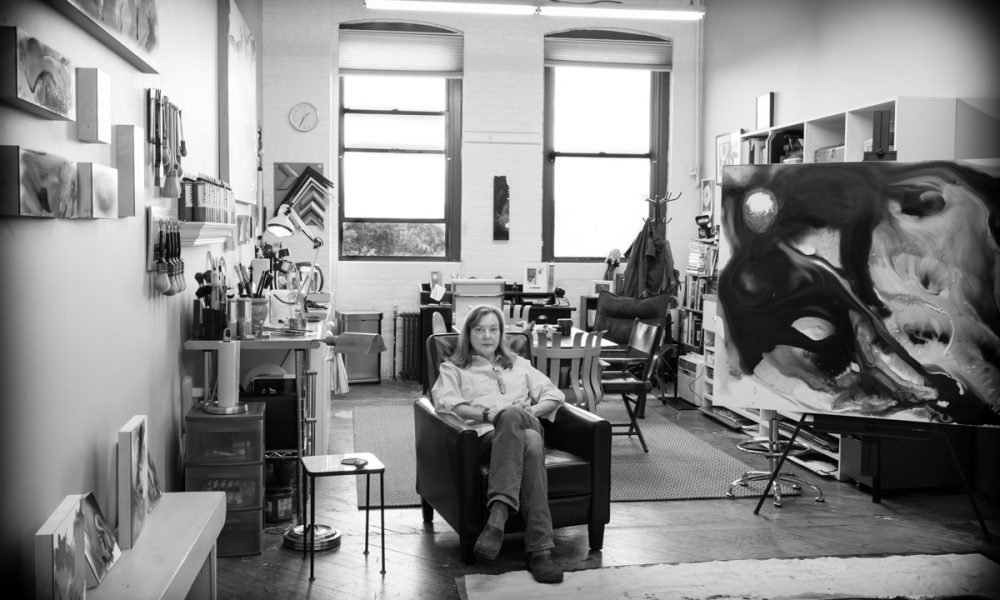
One of the first things Jeannie Motherwell will tell you about her paintings is that kids “just go bananas over them.” They walk straight in, no map, no ticket. They get them right away. Sometimes they’ll go home and draw her a picture back as a kind of response. Adults, being adults, move immediately to reference points: It’s the cosmos, it’s tidal wrack, it’s a mossy tumble or the ragged end of rough weather. It’s a bloom.
Motherwell grants that all of that feeds her but none of it is the subject. People confuse accessibility with the simplicity of formal understanding, which is how Motherwell’s kind of work always finds someone muttering that their kid could do this. But what the kid enters at that immediate level and simply lives in is what the rest of us have been trained to “define out,” as she says, to frame. When we do this, we lose the actual experience and co-authorship that create an “it” that tests our boundaries and hopefully dissolves them. And every frame is a small goodbye.
For years, Motherwell has worked on the floor, pouring onto rigid, smooth clayboard, and letting the material make many of the decisions. The results looked magical, and that was the problem. Magic became something too predictable, a “habit.” She’s outgrown it. She wants more engagement, so the canvases are back with their resistance, the brushes back with their lack of mercy.
She has a keen desire to rule out anything that doesn’t earn its keep. She also destroys fewer paintings than she used to, she says, “because I’d rather solve them,” which is not the same as completing them. Her best have been her hardest, “because I didn’t understand them.” Dirty Water was done when she didn’t know what to do with it, and let that question stand as its strength.
This is where Motherwell’s current work steps past what she’s done before, and past abstraction and process painting. Mid-century painting made the canvas an arena and the painter its hero with emotion, or made it a vehicle for legitimizing the overlooked. Process painting handed decisions to the material. Motherwell has left the building. Emotion and wonder are still present, form and composition acknowledged. She used to say that “it’s not about outer space, it’s about space in general.” But now it’s not even space. It’s what makes space. Compression, release, cadence, emergence. Contradiction. Infinity.
Stand still, and the events in these paintings argue, as a pour collides with a stroke, a stain picks a fight with a field, and back-painting talks an impulse down. Let yourself move, though, and things simply happen, together, continuous. Ecology has a word for systems like this: sympoiesis. It means things arise together, no autonomy, no steady state, no guarantees. Ourselves included.
Motherwell holds all of it “without letting them collapse all together and also without letting any one of them take over.” Even the edges stay open, unresolved: “Just because there’s an edge doesn’t mean it ends.” “I feel like I’m in some very expansive territory where I’m very small and now I feel like I’m pulled in at the same scale and sometimes it’s a little invasive. Sometimes I recognize some part of myself that I haven’t seen and that I’m not sure I want to look at.”
That may be where we all find ourselves right now. Wanting the experience, the real, to keep looking. Denotations, the title of this show, is the word for what things are, not what they suggest. These paintings do not explain. There is no connotation. These paintings are not about. They are.
Motherwell has given up control of the outcome to gain control of the experience. You receive that experience directly before any explanation arrives, the way children do. Not because they are innocent. Because they are connected.
– Jesa Damora
October 13, 2026
Header photo from the BostonVoyager